
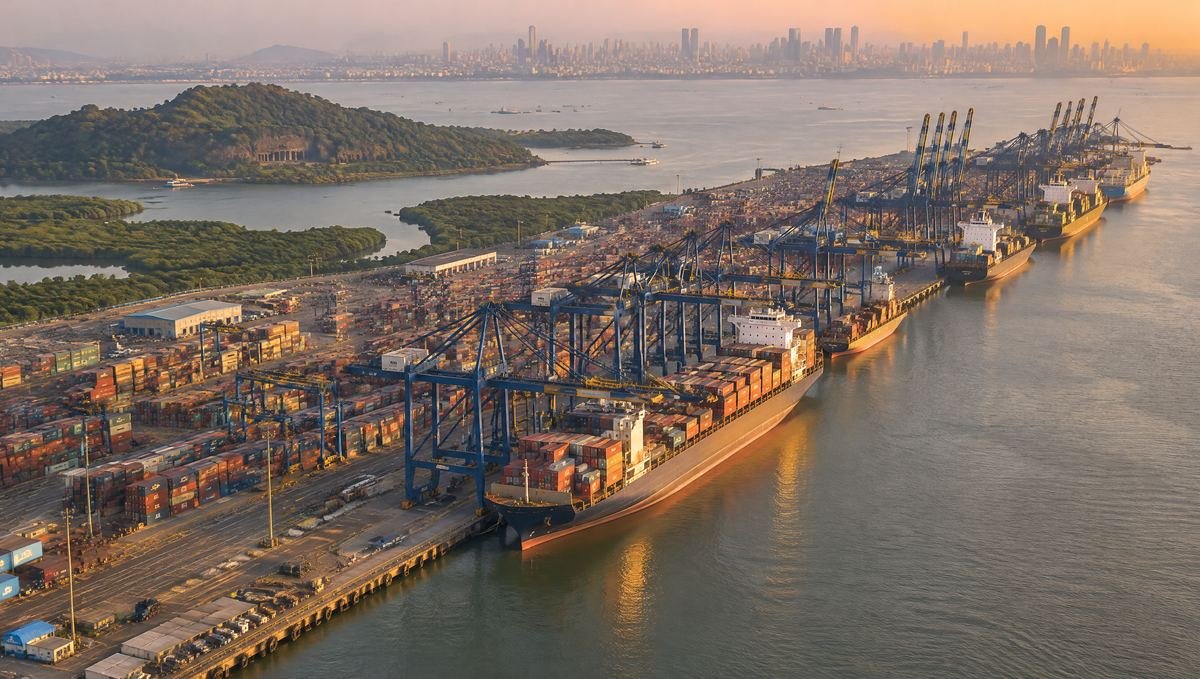
JNPA (Nhava Sheva)
The Jawaharlal Nehru Port Authority at Nhava Sheva, across Mumbai harbour in Raigad district, is India's busiest container port. It handled a record 8.17 million TEUs in the financial year 2025–26, up from 7.3 million the year before, and about 102 million tonnes of cargo in all.
History
The port opened in 1989 to take container traffic away from the crowded docks of Mumbai Port. Built on reclaimed land at Nhava Sheva, it grew quickly as India's trade containerised, and private operators were brought in to run new terminals from the late 1990s.
Terminals
- JNPA's own container terminal, now run by a private operator.
- Nhava Sheva International Container Terminal and Nhava Sheva (India) Gateway Terminal, run by DP World.
- Gateway Terminals India, run by APM Terminals.
- Bharat Mumbai Container Terminals, run by PSA, the port's newest and largest terminal.
- A shallow-water berth and liquid cargo berths for chemicals and petroleum products.
Connectivity
JNPA is linked by rail to inland container depots across India, and is being connected to the Western Dedicated Freight Corridor for double-stack trains to the north. By road, the Atal Setu sea bridge (opened 2024) links it to Mumbai, and highways run to Pune and the Mumbai–Ahmedabad corridor. Navi Mumbai International Airport is next door.
Trade lanes and cargo
Direct services connect JNPA with the Gulf, the Red Sea, Europe, the Mediterranean, the US East and West coasts, Africa, Southeast Asia and the Far East. It handles a large share of India's container trade: engineering goods, pharmaceuticals, chemicals, auto parts, textiles, grapes and other agricultural exports, and imports of machinery, electronics and consumer goods.
What it means for shippers
For almost all of Maharashtra, JNPA is the container gateway. For rail cargo from the north, and for northern Maharashtra, compare it with Mundra using our port selector, or price a shipment with the cost estimator.